
Strava guides 5 MIN READ
Your front door is in that file
Every route you have recorded starts and ends in the same place. What that means when a print goes on a wall, or a file goes in an email.
A route file is a list of places you were, in order, with times. The first entry is where you left from. For most people, most of the time, that is home.
This is not hypothetical
It is the oldest known problem with fitness data. Aggregate activity maps have exposed the locations of military bases; individual routes have been used to work out where people live and when they are reliably out.
Nothing here requires sophistication. The first coordinate of the file is a latitude and a longitude to five decimal places, which is roughly a metre.
Privacy zones help less than you would hope
Strava offers privacy zones: draw a circle around an address and the start and end of activities inside it are hidden.
They are worth using. They are also weaker than they appear. Researchers at KU Leuven showed in 2023 that zones could be reverse-engineered with high accuracy, by combining the distance reported inside the hidden section with the local street layout. If a route enters a zone and covers 400 m before appearing, and only a few streets can produce that, the set of possible addresses is small.
More practically: a privacy zone protects what Strava shows. It does not protect a GPX file you exported and emailed to a print shop. The export is your data, and your data starts at your door.
What we do
Every route is trimmed before it is drawn. Five hundred metres off each end by default, adjustable up to two kilometres, and never less than a hundred.
It happens in your browser for uploaded files, and on our side for routes read from a connection — because there the coordinates travel over a network, and untrimmed coordinates should not exist in a response at all, not even one on its way back to their owner.
The visible cost
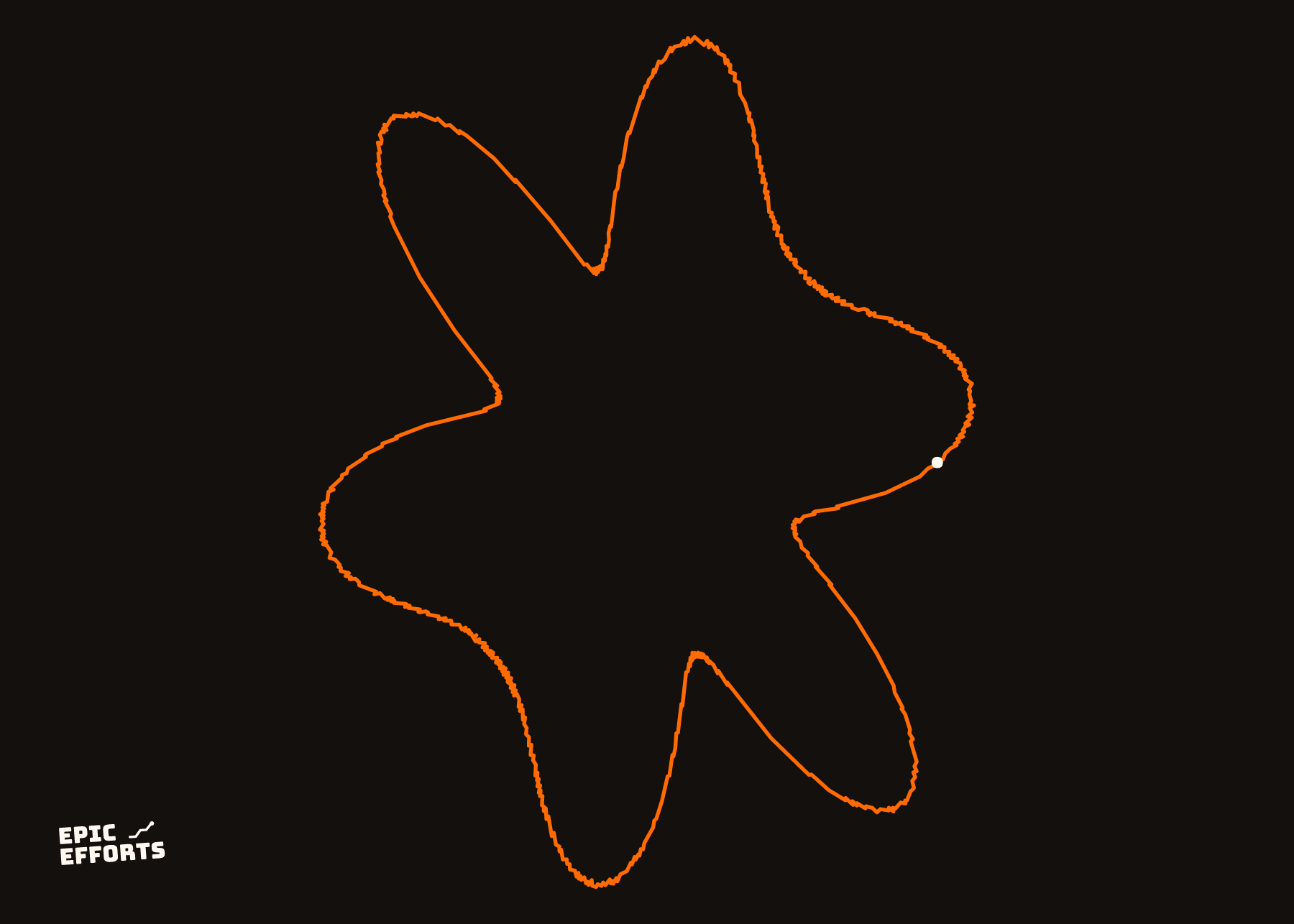
A trimmed loop has a small gap where you set off. On an out-and-back, both ends stop short.
That is a real aesthetic cost and it is worth it. Most routes are loops, where the gap reads as a deliberate opening rather than an error, and the numbers underneath are untouched because they come from the file rather than from measuring what is left.
Questions people actually ask
- How much do you trim by default?
- 500 metres from each end, adjustable up to 2 km. The minimum is 100 m — it cannot be switched off entirely.
- Does trimming change the distance on the print?
- No. The shape is trimmed; the numbers come from the file's own metadata. A trimmed 222.7 km ride still prints 222.7 km.
- Can I turn it off?
- Not to zero. A print with your doorstep on it is a bad object to hang in a room strangers walk through, and the smallest setting still removes the first hundred metres.
- Is a heatmap worse than a single route?
- Considerably. One route reveals a home once. Three hundred routes reveal it three hundred times, converging on a single point that is the darkest thing on the sheet.
YOURS, FROM A FILE, IN 90 SECONDS
One effort. One sheet of paper.
Bring the file and every choice is yours: paper, treatment, colour, which numbers come along. Uncoated matte in 250 or 170 gsm, made to order at the facility nearest you, rolled in a tube.
Print it. FROM 319 kr