
Field notes 4 MIN READ
The only product where the verb is what you do with it
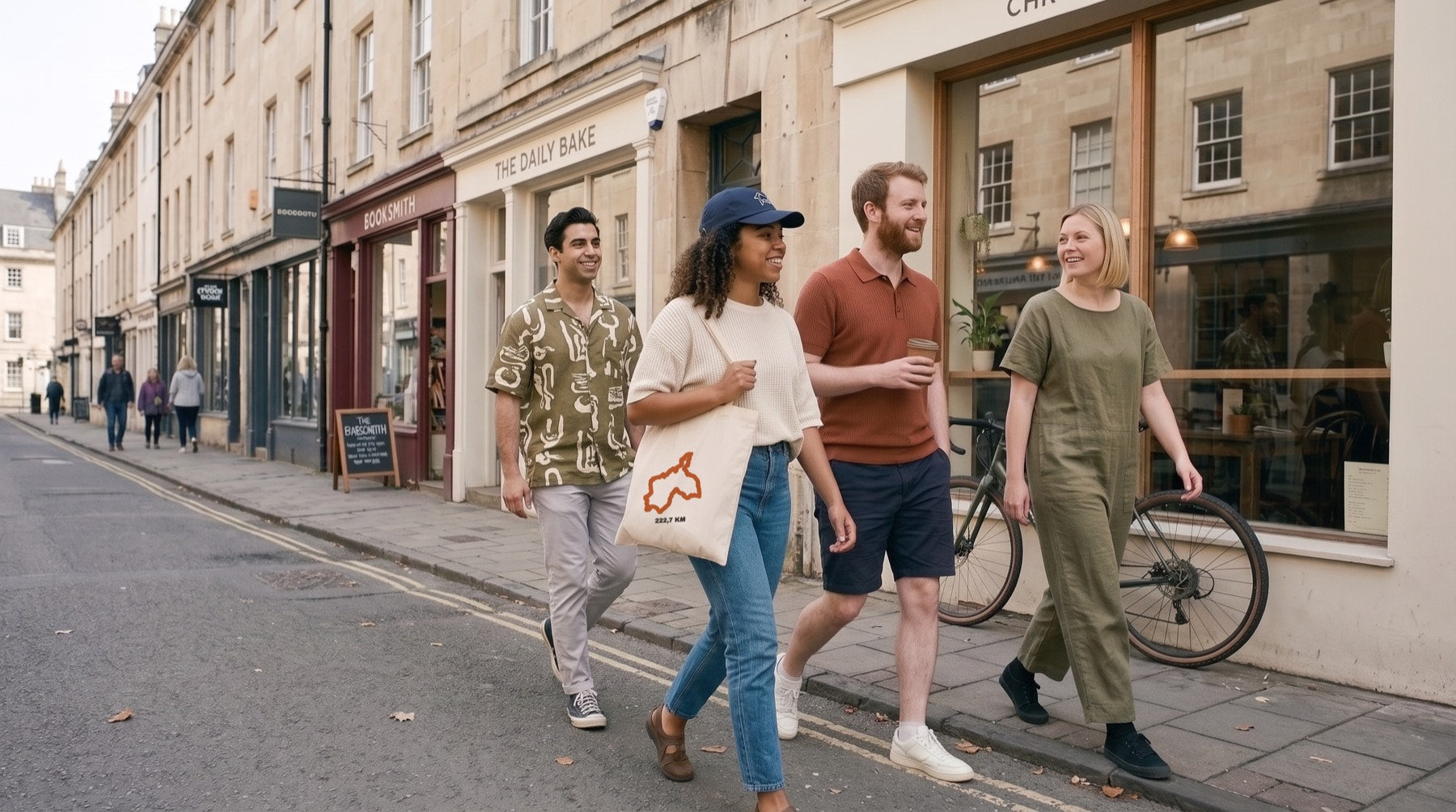
Every other print goes on a wall. A tote goes back out to the water with you, which changes what belongs on it.
Most of what we make ends up on a wall, where it stays still, stays clean, and gets looked at in good light. A tote does none of those things. It gets stuffed with a wet cag and a flask, dropped on a slipway, and carried in the rain.
That changes what belongs on it.
Fewer points, heavier line
A poster can carry a thousand points of geometry, because the paper holds detail and nobody rubs it. Canvas cannot. The line is redrawn with roughly a third fewer points and a substantially heavier stroke — anything finer than about four points breaks up after twenty washes, and a print that fades is worse than no print at all.
The result is a simpler drawing. That is not a compromise so much as a different reading of the same route: the shape survives, the wobble does not.
Why paddling suits it
Water routes tend to have exactly the qualities that survive simplification. A crossing is a long confident line. A coastal paddle traces something that already has a shape — a bay, a headland, an island you went round. There is very little fine detail to lose, because there were no junctions to make and no streets to follow.
An estuary paddle at low water is the exception, and a good one: all those channels and sandbanks produce a genuinely intricate track. On paper it is beautiful. On a bag it turns to mush. Print that one and hang it.
The practical bit
Heavy organic canvas, long handles, natural or ink. It is the one product where the second verb is not a metaphor — you actually carry it, and it will look better in two years than it does now.
YOURS, FROM A FILE, IN 90 SECONDS
One effort. One sheet of paper.
Bring the file and every choice is yours: treatment, colour, which numbers come along. Museum-grade 250 gsm matte, printed in Denmark, shipped in a tube with a nail taped inside.